

Laser Welder Not Emitting Light — What to Do?
As technology keeps advancing, lithium batteries are used ever more widely in every field — mobile phones, electric vehicles and more. Lithium batteries offer small size, light weight, high energy density and low self-discharge,
which makes them an ideal energy storage device. However, the safety and reliability of lithium batteries are crucial to their performance and service life. To improve both, laser welding technology emerged. Xinde Laser will now explain in detail the working principle of the lithium battery laser welder.
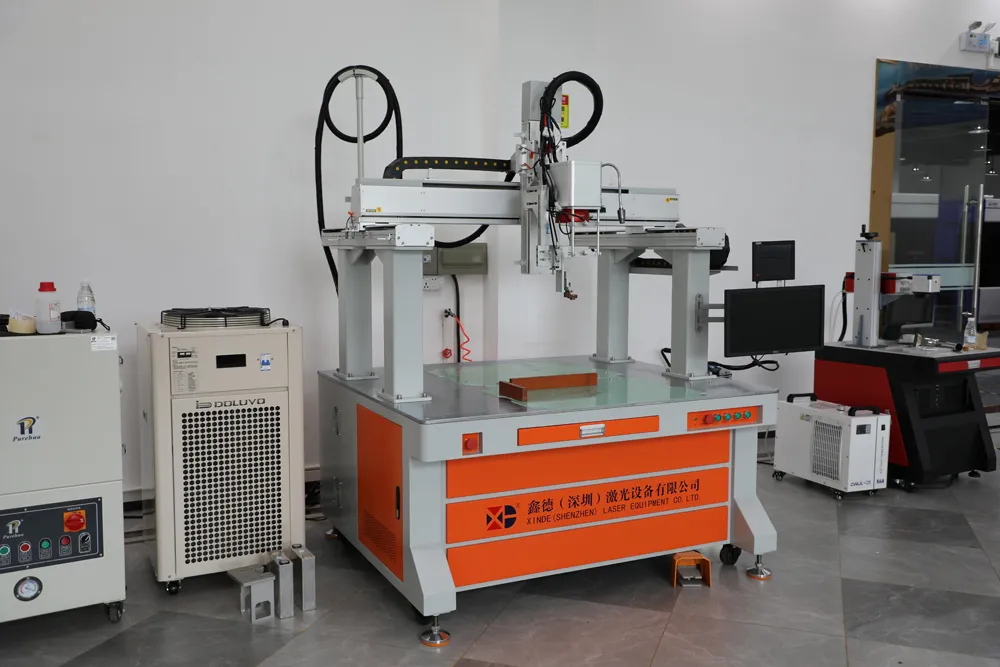
1. Principle of lithium battery laser welding technology
Laser welding is a process that uses a high-energy laser beam to heat and melt material so as to join it. Lithium battery laser welding focuses the high-energy beam produced by the laser between the positive and negative electrodes of the cell; by controlling laser power and speed, the seam between the electrodes melts and forms a continuous weld. This welding
method offers high precision, high speed and a small heat-affected zone, and can effectively improve the safety and reliability of lithium batteries.
2. Structure of a lithium battery laser welder
A lithium battery laser welder mainly consists of the following parts:
1. Laser: generates the high-energy beam, usually a CO2 laser or an Nd:YAG laser.
2. Control system: precisely controls parameters such as laser power and speed to ensure weld quality. Control systems are usually digital, with fast response and
good stability.
3. Worktable: holds the positive and negative electrodes of the cell and provides a stable working platform. It usually adopts a motorized lift structure so that height and position can be adjusted as needed.
4. Cooling system: removes the heat generated during welding to prevent overheating damage to the weld zone. It usually uses water or air cooling.
5. Inspection system: monitors weld quality in real time, checking parameters such as seam width and flatness. It usually uses optical microscopes, interferometers and similar equipment.
3. Working process of a lithium battery laser welder
1. Preparation: first clean and deburr the positive and negative electrodes of the cell to ensure seam quality. Then place the electrodes on the worktable and fix them with fixtures.
2. Parameter setting: set laser power, speed and other parameters according to the structure and requirements of the cell. At the same time, set a suitable welding path and spacing to ensure seam quality
and appearance.
3. System start: press the start button and the control system begins to work. The laser generates a high-energy beam which the focusing lens concentrates on the seam between the electrodes.
4. Welding process: when the beam hits the seam it generates a large amount of heat that melts it. Precise control of laser power and speed keeps the melting and solidification of the seam under control, achieving high-quality welding.
5. Inspection and correction: after welding, the inspection system checks the seam — width, flatness and so on. Where results are unsatisfactory, welding parameters can be fine-tuned through the control system to achieve the desired result.
4. Advantages of lithium battery laser welding technology
1. High precision: because laser power and speed can be precisely controlled during welding, very high precision can be achieved to meet the special requirements of lithium batteries.
2. High efficiency: compared with traditional manual welding, lithium battery laser welders are far more productive and can greatly increase production speed.
3. No pollution: the lithium battery laser welding process produces no harmful gas or wastewater, which benefits the environment.
4. Stable quality: thanks to the automated control system, lithium battery laser welders can run continuously with stable and reliable product quality.
5. Wide applicability: lithium battery laser welding can be used not only for lithium-ion battery production, but also for other battery types (lead-acid batteries, fuel cells and so on).
manufacturing.