

Laser Welding Principles and Parameter Settings for Laser Welders
Laser welding uses high-energy laser pulses to heat a tiny area of the material locally; the energy of the laser radiation diffuses into the material by heat conduction and melts it to form a specific molten pool. It is a new welding method, aimed mainly at thin-wall materials and precision parts. It can do spot welding, butt welding, lap welding and seal welding, with a high depth-to-width ratio,
a narrow seam, a small heat-affected zone, little distortion, high welding speed, and a smooth, attractive seam that needs no post-treatment or only simple treatment. Weld quality is high and pore-free; it is precisely controllable, the focused spot is small, positioning accuracy is high, and automation is easy.
Laser welding is an efficient, precise method that uses a high-energy-density laser beam as the heat source, and is one of the important aspects of laser material processing technology.
China is at the world advanced level in laser welding, with the technology and capability to laser-form complex titanium alloy components of over 12 square meters, which have gone into prototypes and products for several domestic aviation research projects.
2013, Chinese welding experts received the Brooker Prize, the highest academic award in welding, confirming that China laser welding level has been recognized worldwide.
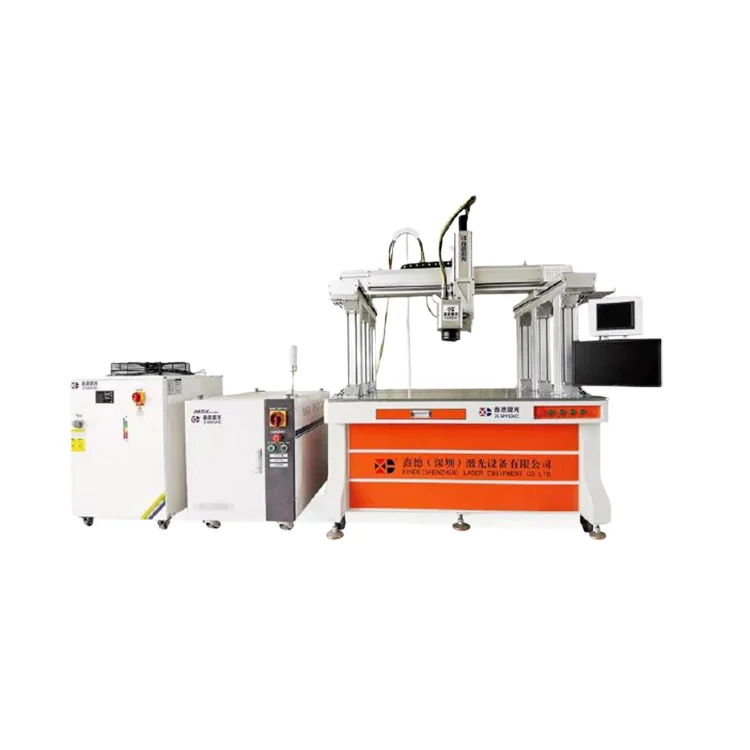
How are the parameters of a laser welder adjusted? When using a laser welder, how do we know which parameters to change? For different materials the parameters differ, so let us look at the parameter settings of a laser welder.
Laser pulse width:
Laser pulse width is an important parameter in the welding process. Pulse width determines the width and depth of the weld, and its setting affects the welding
result: the longer the pulse width, the larger the heat-affected zone, and penetration depth increases with the square root of the pulse width. In fact, for every material there is an optimal pulse width that maximizes penetration.
Laser power density:
Laser power density is one of the most critical parameters in laser processing. In laser welding there is a threshold of laser energy density: below it penetration is very shallow, but once it is reached or exceeded,
penetration rises sharply. Therefore, the higher the power density, the faster the workpiece surface heats to boiling point. With high power density the surface can be heated to boiling within microseconds,
producing heavy vaporization. High power density therefore favors material removal processes such as drilling, cutting and engraving. At lower power density it takes several milliseconds for the surface to reach boiling point; before the surface vaporizes the lower layer reaches melting point, which easily forms a good fusion weld.
Laser pulse waveform:
The laser pulse waveform is an important issue in laser welding, especially for thin-sheet welding. When a high-intensity beam strikes the material surface, 40–70% of the laser energy is reflected and lost by the metal surface, and reflectivity varies with surface temperature. Within one laser pulse the reflectivity of the metal changes greatly, so different metals differ in their reflectivity and in how they use laser energy; effective welding requires inputting different waveforms, so that the metal structure at the seam crystallizes in the best way
and forms a structure consistent with the base metal, producing a high-quality weld. In practice the pulse waveform can be flexibly adjusted to the welding characteristics of each material. For brittle materials, for example, a waveform with slowly decreasing energy can be used to slow the quench rate.
Adjusting the parameters of a laser welder mainly means setting the laser pulse width, laser power density and laser pulse waveform; different welding materials call for different commissioning data. These are the three main points — users can adjust the welder parameters themselves according to the material being welded.