

Continuous vs. Pulsed Laser Welding — How to Tell Them Apart?
Laser welding uses a high-energy laser beam as the heat source; by controlling parameters such as laser pulse width, energy, peak power and repetition rate, the workpiece is melted to form a specific
molten pool.
Advantages of laser welding:
1. Suitable for precision and fine welding of small and micro metal workpieces;
2. Compared with other welding processes, laser welding produces a much smaller heat-deformation range on the workpiece surface;
3. It can weld thin metal sheets with relatively high efficiency, and is widely applied across industries;
Disadvantages:
1. It places high demands on the weld gap, which generally must not exceed 0.1-0.3 mm; for workpieces with a gap larger than 0.1 mm, an oscillating welding head is normally used;
2. Current laser equipment is relatively bulky, not easy to carry, and not suited to outdoor work;
3. Compared with traditional welding equipment such as argon arc welding, the one-time investment cost is higher;
The welds produced by Shenzhen Xinde Laser's welding equipment are smooth and flat with no bubbles; material deformation is small, the heat-affected zone is small, and the process is pollution-free.
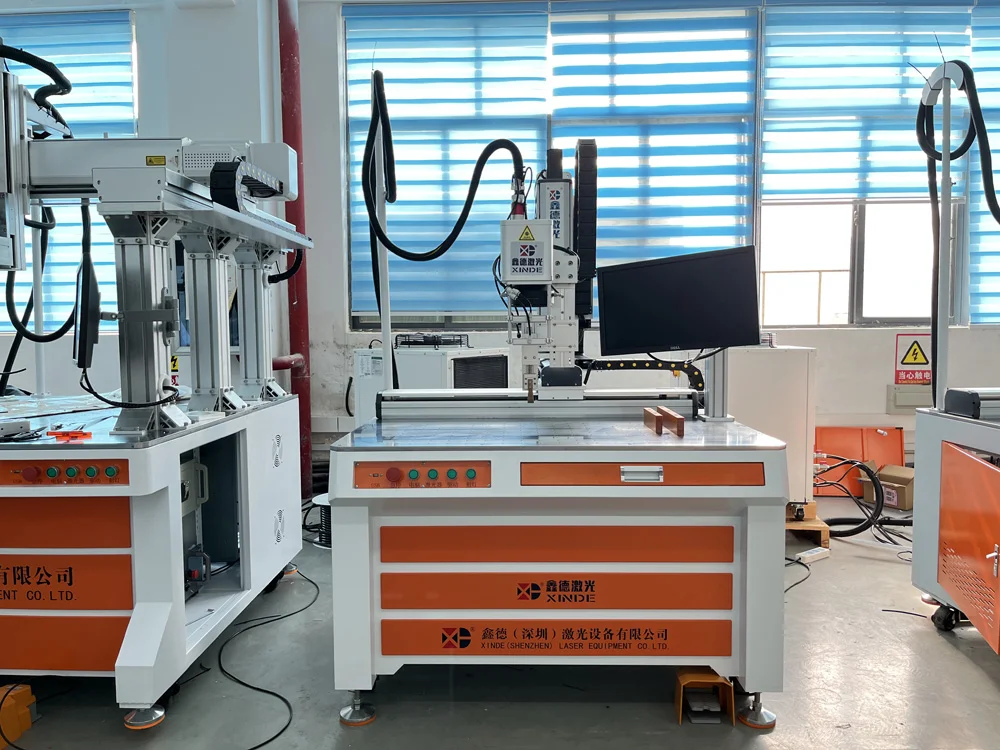
Laser welding can be divided into two types, continuous laser welding and pulsed laser welding.How do the two differ?
Continuous laser welding mostly uses high-power lasers, generally above 500 W, and plates thicker than 1 mm are typically welded with this type of laser. Its welding principle is
based on keyhole-effect deep penetration welding, with a large depth-to-width ratio of more than 5:1, fast welding speed and low thermal deformation. Continuous lasers generally deliver lower output power, suiting situations
that require the laser to run continuously, and they are widely used in machinery, automotive, shipbuilding and other industries.
Pulsed laser welding is mainly used for spot and seam welding of thin-wall metal materials under 1 mm thick; laser radiation heats the workpiece surface and the heat then diffuses into the material by conduction.
Its greatest advantage is that the temperature rise of the workpiece is small, the heat-affected zone is small and material deformation is small. Pulsed lasers have high peak output power and are widely
used in lithium batteries, electronic components, power batteries and other industries.