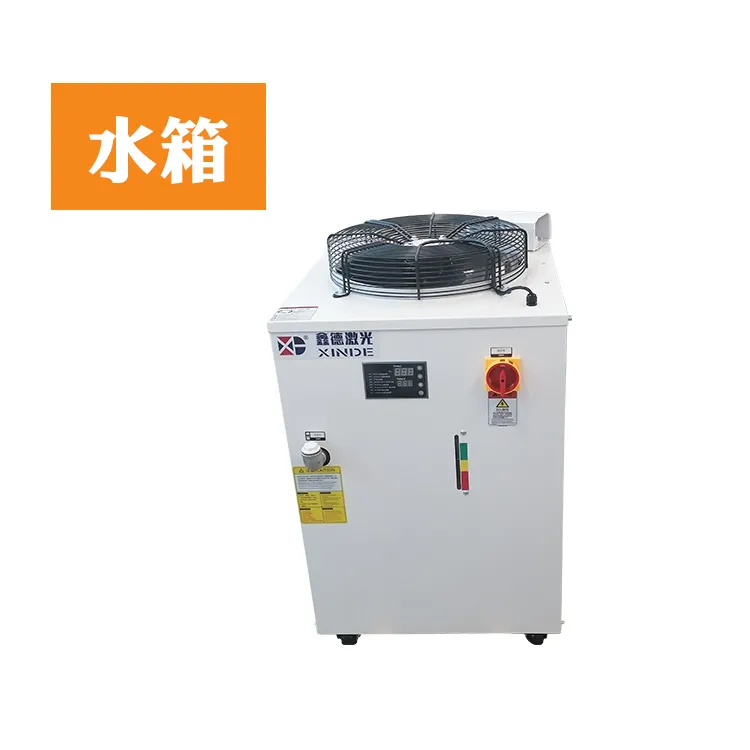

How Does a Laser Welding Machine Cooling System Work?
The cooling system is an important part of a laser welding machine. When customers buy equipment, they ask whether the cooling is air-cooled or water-cooled. If the cooling system fails, the equipment stops running; if it is damaged, it may explode.
Cooling systems are classified by medium into air-cooled and water-cooled. A system that directly dissipates the heat of high-temperature engine parts into the atmosphere is called an air-cooling system;
while a system that first transfers this heat to cooling water and then dissipates it into the atmosphere is called a water-cooling system. Water cooling has the lowest cost and offers uniform, effective cooling, so it is widely used.
A laser welding machine's water chiller generally has a filter that effectively removes impurities from the water, keeps the water pump clean, and prevents clogging. Use pure or deionized water in the chiller,
plus a pressure gauge to observe water pressure. The chiller typically uses 220V household power instead of three-phase power, which better suits general-purpose equipment. The laser welding machine's chiller has
temperature protection—if the temperature is too high or too low, a signal alerts and alarms. The chiller's bottom has oil-flow protection; when the water flow is set, a signal alarms to protect
the laser source and related heat-sink components. The chiller's water tank and pump are made of stainless steel, which makes the chiller more stable and improves cooling performance.